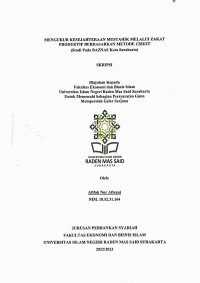
SKRIPSI PBS
MENGUKUR KESEJAHTERAAN MUSTAHIK MELALUI ZAKAT PRODUKTIF BERDASARKAN METODE CIBEST (Studi Pada BAZNAS Kota Surakarta)
ABSTRACT Poverty is still a major problem in several developing countries, including Indonesia. The poverty rate in Indonesia has now reached 14% of the total population. Meanwhile, the poverty rate in the city of Surakarta is classified as unstable, which means that the development process carried out by the Surakarta government has not gone well. In 2020 the poverty rate in the city of Surakarta has increased by 47.03 thousand people or equivalent to 9.03 percent. Therefore there are several government programs to overcome poverty so that the problem of poverty can be resolved immediately. Zakat is an alternative to government programs to overcome poverty problems. This study aims to determine the difference in income before and after receiving productive zakat and to determine the mustahik grouping in the CIBEST quadrant before and after receiving productive zakat funds. This type of research is quantitative using a sampling technique in the form of non-probability sampling. The data analysis used is the T test and the CIBEST method. The results obtained using the paired t test show that there is a difference in the average mustahik income before and after receiving productive zakat funding assistance. The average income of mustahik before receiving productive zakat is Rp. 1,421,667 and after receiving productive zakat assistance of Rp. 1,951,667. There is a change in mustahik's income of Rp. 510,000. The results using the CIBEST method are as many as 51 mustahik belonging to quadrant I or prosperous, 7 mustahik belonging to quadrant II or materially poor, then there are 2 mustahik belonging to quadrant III or spiritually poor and 0 mustahik belonging to quadrant IV or absolute poor. Keywords: Zakat, Productive Zakat, CIBEST Model
Ketersediaan
Tidak ada salinan data
Informasi Detail
- Judul Seri
-
-
- No. Panggil
-
2X6.1 AFI m 23
- Penerbit
- SUKOHARJO : Perbankan Syariah_UIN RM Said., 2023
- Deskripsi Fisik
-
21 cm, 63 halaman
- Bahasa
-
Indonesia
- ISBN/ISSN
-
-
- Klasifikasi
-
2X6.1
- Tipe Isi
-
-
- Tipe Media
-
-
- Tipe Pembawa
-
-
- Edisi
-
-
- Subjek
- Info Detail Spesifik
-
-
- Pernyataan Tanggungjawab
-
Afifah Nur Afiyani
Versi lain/terkait
Tidak tersedia versi lain
Lampiran Berkas
Komentar
Anda harus masuk sebelum memberikan komentar
 Karya Umum
  Filsafat
  Agama
Agama  Ilmu-ilmu Sosial
  Bahasa
  Ilmu-ilmu Murni
  Ilmu-ilmu Terapan
  Kesenian, Hiburan, dan Olahraga
  Kesusastraan
  Geografi dan Sejarah