SKRIPSI PBS
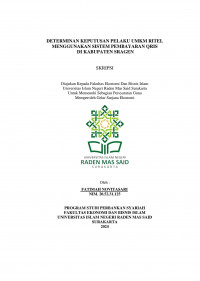
DETERMINAN KEPUTUSAN PELAKU UMKM RITEL MENGGUNAKAN SISTEM PEMBAYARAN QRIS DI KABUPATEN SRAGEN
ABSTRACT
Cashless payments become a digitization method of UMKM, which is
efficient and helps economic growth. Payment using the Quick Response Code
Indonesian Standard (QRIS) is proliferating. It continues to increase the number
of merchants. However, the number of QRIS transactions tends to be low
because the presence of merchants is not evenly distributed throughout the
region, and there are still many elderly UMKM players who are less familiar
with technological advances.
This study aims to determine the effect of perception of benefits, perception
of ease, and perception of risk on the decision of retail UMKM players to use
the QRIS payment system in Sragen. In this study, usage decisions are the
dependent variable, while the perception of benefits, ease, and risk are
independent variables. The research method used is quantitative research. The
population of this study was retail UMKM players in Sragen. The sampling
technique is non-probability sampling, and the method used is purposive
sampling. The data source of this study uses primary data obtained from
respondents’ answers through a questionnaire with a sample of 100
respondents. The data analysis technique uses multiple linear regression with
the assistance of SPSS Statistics 25.
The research results indicate that the perception of benefits has a positive
and significant impact on the decision to use QRIS, as evidenced by the
calculated t value (4.900) ≥ t value (1.660), with a significance value of 0.000 ≤
0.05. Similarly, the perception of ease has a positive and significant influence
on the decision to use QRIS, as calculated t value (4.697) ≥ t value (1.660), with
a significance value of 0.000 ≤ 0.05. Furthermore, the perception of risk has a
positive and significant effect on the decision to use QRIS, with the calculated t-
value (3.074) ≥ t value (1.660) and a significance value of 0.003 ≤ 0.05.
Keywords: Perception of Benefits, Perception of Ease, Perception of Risk, Usage
Decision
Ketersediaan
Tidak ada salinan data
Informasi Detail
- Judul Seri
-
-
- No. Panggil
-
2X6.1 FAT d 24
- Penerbit
- SUKOHARJO : Perbankan Syariah_UIN RM Said., 2024
- Deskripsi Fisik
-
21 cm, 94 Halaman
- Bahasa
-
Indonesia
- ISBN/ISSN
-
-
- Klasifikasi
-
2X6.1
- Tipe Isi
-
-
- Tipe Media
-
-
- Tipe Pembawa
-
-
- Edisi
-
-
- Subjek
- Info Detail Spesifik
-
-
- Pernyataan Tanggungjawab
-
Fatimah Novitasari
Versi lain/terkait
Tidak tersedia versi lain
Lampiran Berkas
Komentar
Anda harus masuk sebelum memberikan komentar
 Karya Umum
  Filsafat
  Agama
Agama  Ilmu-ilmu Sosial
  Bahasa
  Ilmu-ilmu Murni
  Ilmu-ilmu Terapan
  Kesenian, Hiburan, dan Olahraga
  Kesusastraan
  Geografi dan Sejarah